About Cambodia
A Brief Introduction
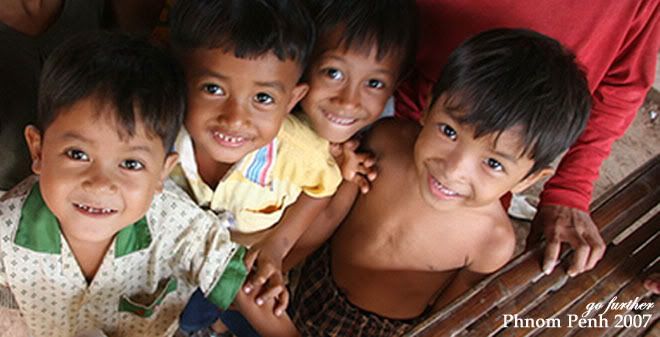
The kingdom of Cambodia, with a population of close to 15 million, is an exotic, mystical, enchanting land with an amazing history, the spectacular ancient ruins of the Angkor Empire, beautiful beaches, remote hill tribe villages and more.
For a small country, Cambodia has excellent name recognition around the world. Unfortunately, only a small part of this is due to the ancient empire of Angkor, where the once powerful Hindu and Buddhist Khmer Empire ruled over vast stretches of the Indochinese peninsula in Southeast Asia for about 500 years and who was responsible for leaving the world an amazing legacy of its genius and glory: the magnificent temples and monuments of Angkor. Neither has this been due to the Cambodia’s status as the Number one tourist destination in Southeast Asia during the relatively tranquil heydays of the late 1950s and the ‘60s, a time when French-style villas dotted the beautiful coastline and mountaintop casino retreats brought in the international jet-set crowd. It was also a time when Phnom Penh’s, the capital, colonial architecture wide tree-lined boulevards and idyllic setting at the confluence of three rivers (Mekong, Sap, Bassac) captivated many a visitor.
Instead of these picturesque images, the name Cambodia conjures up with images of “Killing Fields” and the murderous Khmer Rouge of the late 1970s. This was a terribly tragic period from which no Cambodian escaped without the loss of family and friends, if they were fortunate enough to live through it themselves. The country’s infrastructure, cultural heritage and identity were all but destroyed.
But the Cambodians are an amazingly strong and resilient people. While not forgetting the past, they took the little that they had and forged ahead, slowly but surely putting back together the pieces of their devastated society, culture and lives up till this day.
Today Cambodia appears to have finally settled into a mode of fairly peaceful coexistence. The Khmer Rouge has been eradicated as a threat to the government and the largely agrarian society. In place is now a government who everyday seek to better the welfare of the people through intense rebuilding of both the economy as well as the country’s infrastructure.
Climate and Geography
Cambodia which covers an area of approximately 181 000 sq. km has a mild tropical climate similar to that of Thailand. It has two main seasons where the rainy season which extends from May to October and usually rains only in the afternoon and the dry season from November to April.
The central areas of the country contain primarily rice paddies, and field s of corn and tobacco. The country is renowned for its many wild animals and is hone to four of the world’s deadliest snakes.
Lower Vietnam was at one time a part of Cambodia. During the French colonial period, the border was chanted by the French, who deemed that their interests were best served by making the change. Up till today historical rivalry still runs high as grudges are still being nursed over the Vietnamese’s assumption of traditional Cambodian land. The people living in this area are historically Cambodians are share the same language and customs as the Cambodian people, even though the Vietnamese have attempted to integrate them into Vietnamese culture and society. However their failure in doing so has resulted in them being deemed inferior. Ironically the Cambodian people themselves also see people inhabiting this region as being beneath them, assuming that they mirror their much hated enemy.
People
A citizen of Cambodia is usually identified as a “Cambodian” or “Khmer” which strictly refers to ethnic Khmers which accounts for 90% of the population. Most Cambodians are Buddhist but the country also has a substantial number of predominantly Muslim Cham as well as ethnic Chinese, Vietnamese and small animist hill tribes.
Official statistics indicating the number of ethnic Khmers incorporate multitudes of ethnic Vietnamese with legal statues who now see themselves as ethnic Khmers. The discrepancy in the actual figure of ethnic Khmers remains a sensitive political issue for the formerly Vietnamese-installed and Vietnamese backed government. Even though it was the Vietnamese who ended the brutal reign of Pol Pot, charted from centuries of fighting wars with Vietnam is so ingrained in Cambodians that there remains rampant anti-Vietnamese feeling in the country
Not only so ancient battles between the Khmers and Thais account for the ancient dislike and distrust between the two people. This was largely due to territorial disputes where resentment and anger, till today, is rooted in the belief that the Thais have claimed many ancient Khmer temple artifacts and natural resources for themselves.
Religion
Buddhism
Most Cambodians are Theravada Buddhists. This school of Buddhism was introduced into Cambodia between the 13th and 14h centuries in India. It follows the original doctrines of Buddha more closely and with less interpretation than other types of Buddhism.
The Khmer Rouge murdered many monks and almost all of their three thousand temples were damaged or destroyed. Thankfully, the end of the Khmer Rouge’s reign of terror saw the restoration and rebuilding of these temples which remains as a central rallying point for most Cambodians.
Other Religions
Muslims in Cambodia originally came from Vietnam in the 15th century. Most of the mosques in Cambodia are concentrated primarily in Phnom Penh where they have been rebuilt after the destruction caused by the Khmer Rouge. Cambodian Muslims belong largely to the ethnic Cham group of people where originated in the Champa Kingdom of South Central Vietnam and changed their religious beliefs from Hinduism to Buddhism and finally Islam.
Hinduism was the ancient religion of Cambodia, mostly before Buddhist times but many Hindu traditions and practices have kept a foothold in modern Cambodian culture and life.
Christianity was brought to Cambodia by the French. Today there is a Catholic minority in Cambodia, many of whom are Vietnamese.
Contributed by Charlena
About The Trip
About Temasek Overseas Outreach
In line with the mission of the college to "Broaden Minds, Touch Hearts and Enrich Lives", the Temasek Overseas Outreach programme is an essential component of the holistic education that Temasek Junior College is proud to offer.
What Are We Doing There This Time Around?
Making the most of this experience, we aim to
learn to make confident, informed decisions in the planning process;
build resilience by living and working in a rugged environment;
learn affirmation and self esteem;
develop effective teamwork and leadership skills; and
appreciate the social and economic issues related to Cambodia
Trip Details
Date:
1 - 12 June 2007
Proposed Itinerary:
1 June, 1905hrs: Depart Singapore for Phnom Penh
2 June: Educational Trip to Tuol Sleng Genocide Museum
3 June - 9 June: Project work in Kampong Chan
10 June: Depart Kampong Chan for Siem Reap
11 June: Educational Trip to Angkor Wat
12 June, 0705hrs: Depart Siem Reap for Singapore
Flight Details
1 June - Depart Singapore for Phnom Penh - Jetstar (3K593); 1905hrs - 2010hrs
12 June - Depart Siem Reap for Singapore - Jetstar (3K596); 0750hrs - 1110hrs
Important Things To Note (For Now)
If you need to change money for the trip - change to USD
Attire:
Please be sensitive about the lifestyle in villages. No shorts for girls, bermudas is okay. Wear light cotton t-shirt. If you like to wear some of your old clothings so that you can leave behind for the villagers - that would be great.
A torch is absolutely necessary for the trip. With spare batts of course. If you can afford a head torch, that would be even better. But they're costly. Good thing about them is that it frees up both your hands.
Mosquito repellent is a must. As well as sunblock. If you need something to cover your face at night, you can buy sandfly netting from the beach road army market (I can show you a sample if need be).
A packing list will be made available soon. Keep checking back!
About Us
Team Members
Publicity
Wong Jiawen Michelle,
Liew Si Qi,
Sumitra Rai,
Anatasya Yolanda Hartono,
Yang Mingjin,
Ng Kang Yu,
Fann Tay,
Ang Liling Jane,
Chen Hao En Ryan,
Han Ying Christal,
Charlena Chua Han Qing,
Chewng Wen Shan,
Zhu Qing Olivia
Programmes
Cheng Ze Xuan Shawn, Lim Wei Sheng Ivan, Leo Kim Sonia, Foo Rui Shan,
Tay Jun Yi,
Choo Xianjun Davin,
Teo Eng Kiong Shawn,
Wang Haoqing,
Chung Su Ling Joanne,
Christina Lim Shi Hoi
Teachers-In-Charge
Mr Kao Jiun Shan
kao_jiun_shan@moe.edu.sg
Miss Alieen Wong
wong_shumin_aileen@moe.edu.sg
Eternally Grateful
For help with the initial setting up of this site,
Yuan Qing 3C/05
(Look at other stuff he does - www.yuanqing.org)
Teresa 3C/05
(Wen Shan and Olivia would not have survived without your help O_O;)

© 2005 Temasek Junior College, 22 Bedok South Road, Singapore 469278.
All rights reserved.
Tel: 6442 8066 Fax: 6442 8762
URL: www.tjc.edu.sg
Calendar
If anyone has any resource that allows us to create a dynamic calendar (or actually even a static one would do), it would help greatly, so poke around for some, thanks!